This is perhaps one of the most common questions I get from golfers about their game as it relates to the physical side of golf.
The golfer will often say, “Wade, I’m not making a big enough or efficient turn and it’s killing my consistency and distance. I need some stretches to help improve my flexibility.”
It’s at this point that I reassure them that they’re in the right place and that there are a lot of things we can do that will improve their turn.
However, this golfer is making a bold assumption…that their lack of turn they may be feeling is because of muscle tightness and that stretching will help improve it….Sounds reasonable right?
It does if, in fact, it’s the muscles that are what’s tight and that stretching is the most effective remedy.
Unfortunately, there are a lot of different reasons why someone may not have good ‘flexibility or mobility’ in their body.
To name a few, it could be due to:
Joint limitations
Neural tension
Fascial tension
Trigger point activity
Hypertrophy
Scarring and fibrosis
Osteoarthritis
Guarding
Overload
Fusion
Inflammation
Ischemia
While I don’t expect you to know what each of these means, the point is, there are multiple reasons why a person can have a limited range of motion in a particular part of their body.
I can’t emphasize enough that only once you know the underlying cause of your limited mobility, can you be prescribed an effective ‘flexibility’ routine. Some mobility problems cannot simply be solved by exercise or stretching alone.
Specific to stretching, it may feel good when you’re done, and it may in fact be the right intervention for you, but that’s only if that was determined by a thorough evaluation to sort through all the potential problems listed above. Otherwise, you may not ever make a lasting change, chasing your tail stretching over and over again, never realizing your full potential for a complete turn in your swing.
Getting to the root cause of why someone is lacking the mobility to make a good turn in their golf game, fixing it through whatever appropriate intervention is warranted, and then following that with a good stability/strength routine afterwards to hit the ‘save’ button on your gains in motion, is one of the most common things I do.
Do you think something is limiting your turn? Let’s get you on a path to success with a targeted, golf-specific mobility program put together by a Doctor of Physical Therapy and TPI Medical Professional.
Dr. Wade Roberts is a contributing writer for Central Links Golf. He graduated from Liberty University with a Bachelor of Science Degree in Kinesiology. He then earned his Doctor of Physical Therapy from Lynchburg College. Dr. Roberts is able to provide specialized therapies for a variety of patients but has a special interest in decreasing pain, increasing speed, and achieving longevity in the golf community.
Question: During our Member-Guest earlier this year. We were playing the gunch as a penalty area. The player hit his ball into the gunch or possibly OB, and proceeded to hit a provisional. While looking for his ball I asked why did he hit a provisional when we are playing this as a penalty area. He says “oh, yeah, I’ll just drop one,” I told him since he already hit a provisional he had to play that. He was not pleased. What’s the ruling?
Answer: If a ball may be possibly OB, the player may play a provisional, even if a penalty area is where the ball could be. This player had the right to play a provisional. However, once it is determined where the ball is or where it is lost, we must proceed with that Rule. So if it was determined the ball was OB, then the provisional becomes the ball in play. If it is determined the ball is in the penalty area, then the provisional must be abandoned, and then proceed under the penalty area rule. Those options are stroke and distance (and cannot use the provisional), back-on-the-line relief, or two club-lengths from where it entered the penalty area. If the player knew the ball was in the penalty area, then yes, you cannot play a provisional, it would become the ball in play.
Todd Stice is our in-house Rules of Golf Expert. You can learn more about Todd here.
Two golfers made holes-in-one on the 17th hole during Thursday’s Falcon Wealth Advisors Tour event at Falcon Lakes, winning them both one-year Toyota car leases.
According to the PGA, the odds of making a hole-in-one on the same course is once in every 3,500 rounds. The last time the Falcon Wealth Advisors Tour had a hole-in-one was nearly eight years ago. So when Jake Falcon owner of Falcon Wealth Advisors said he wanted to give away a one-year Toyota lease to golfers who made a hole-in-one on Tour this year, we didn’t think it would happen, and we certainly didn’t think it would happen TWICE in the same day.
Falcon remarked, “when Todd told us that there had not been a hole-in-one on the tour in the last eight years we found that hard to believe, I guess it’s been far overdue.”
In order to win a car on tour, the golfers must make a hole-in-one on a predetermined hole in each event. Thursday’s hole was #17, golfers must carry their tee shot over a creek with bunkers guarding the left side of the green and sloping off the right side of the green, the 17th green is deep and narrow, forcing golfers to choose the right club.
The first hole-in-one of the day was carded by Pete Robbins. Playing in the Super Senior Division, Pete had a 155-yard shot and used a 6-iron from a new set of clubs he played with for the first time during his round on Thursday. Robbins is headed to the Kansas Senior Amateur next week. When asked if he plans to continue using the new clubs he replied “yeah, I think I’ll keep them in the bag”.
The second hole-in-one was made by Brian Schmidt, who played in the Players Division. Schmidt’s shot was from 178 yards and he used a 5 iron, making this his first career hole-in-one. “I couldn’t have hit it any better,” Schmidt noted about the shot “This is my first year playing in the FWA Tour and I couldn’t have picked a better way to make a hole-in-one.”
Falcon has been a member of the FWA Tour for many years, when the tour was previously known as the Stateline Amateur Tour.
“We are thrilled for Pete and Brian and are glad that this brings more notoriety to KC’s best Amateur Tour! The tour players should know that the hole-in-one hole will be quite a bit more challenging the rest of this season. They can thank Pete and Brian for that, haha!”
Storyby Kim Richey (retired Kansas Golf Association Executive Director)
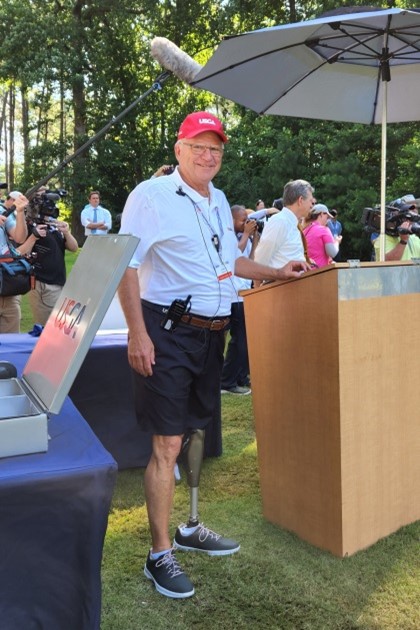
It has been my honor to represent Kansas at over 30 USGA championships since 1995 as a member of the rules committee. Whether it is a US Open or a national amateur championship, the USGA always goes the extra distance to make the event memorable for the players and historical in the world of golf. The Inaugural US Adaptive Open Championship recently conducted at Pinehurst #6 was, according to one USGA executive, “one of the best things the USGA has ever done!”
Having been delayed two years by a pandemic, the launch of this Open championship for golfers within 8 classifications of disability assembled an inspirational field of 96 golfers from around the world who played 54 holes to determine an overall champion for both men and women and the top male and female player in each of the categories. One of those golfers was Greg Hollingsworth from Peck, Kansas.
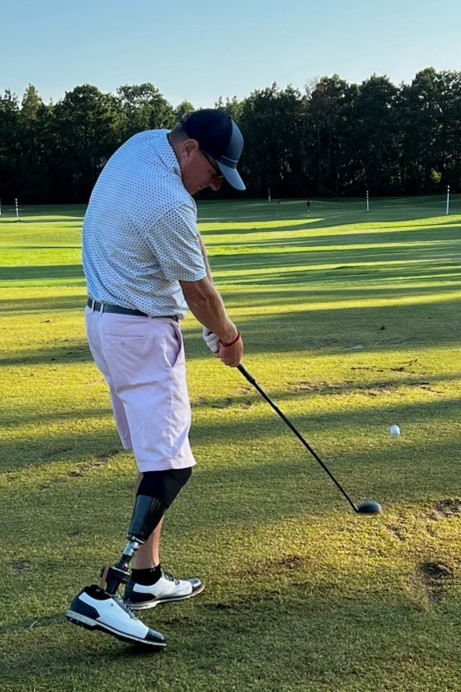
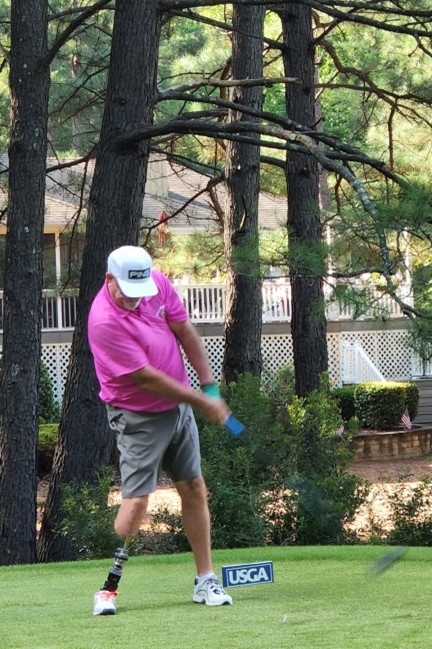
Hollingsworth, age 53, competed in the leg impairment category. His right leg was amputated below the knee in 2019. This was only his fifth competition since his amputation and for it to have been a “US Open experience” was truly special for the self-employed electricity safety consultant.
While Greg admits that he did not play as well as he would have liked, he can’t be faulted for it. For the first two rounds, he was paired with a young professional from Korea that played in the Intellectual Impairment category. His name was Simon Lee and the following he had of Korean media, ESPN and other media would make any golfer nervous. Turns out, Lee lead the event wire-to-wire shooting under par, and became the eventual overall champion surviving a 2-hole aggregate playoff on the final day.
After the golfing experience of a lifetime, Hollingsworth commented that “my score and results were just a piece of the week for me. I received so many texts, emails, messages on social media, and phone calls encouraging me and letting me know that my play and play of all participants was inspiring and helping people to know they can do hard things. I have to remember that sometimes it’s not all about the golf!”
Hollingsworth reports that he has two more adaptive golf competitions on his schedule for this year and he is entered in the Kansas Senior Amateur Championship to be played in August at Terradyne Country Club in Andover, Kansas.
For me personally, the US Adaptive Open had a special significance. I became a member of this “community” myself in 2017 when a life-saving above left knee amputation cured me of a sarcoma cancer. When the USGA announced the formation of a feasibility study to create a championship for golfers with disabilities, I was quick to raise my hand. The USGA staff did all of the hard work to get this new championship off to a successful start, but I was happy to provide a few ideas on the subject.
If you did not see or read any of the coverage of this amazing event, a quick Google search of “US Adaptive Open Championship” will lead you to some outstanding video of these remarkable golfers.
Here are some of the players that I was fortunate to meet:
Amy Brockerstette, from Phoenix, Arizona. This engaging young woman became our Gary Woodland’s new best friend at the 2019 Waste Management Open PGA Tour stop when during a practice round with Gary, she single-handedly parred the 16th “stadium hole” in front of the large crowd. When Gary asked Amy if she would like him to extract her tee shot from the greenside bunker, her response was simply “I’ve got this”! Gary claims her attitude and spirit inspired him to go on to win the 2019 US Open at Pebble Beach. While meeting Amy and her parents and taking a few photos together, Amy was busy texting the photo to Gary! Turns out anyone that knows Gary is Amy’s friend too!
Chad Pfiefer from Boise, Idaho. Chad led the way for golfers with leg impairments. The Army vet has managed to develop a very strong and solid golf game. He played his way into the final group for the last day and I was honored to be assigned to that group as its rules official. He shot the low round of the event with a 4-under par 68 on a 6600 yard Fazio layout. He finished at even par for the championship, three strokes behind the winner Simon Lee.
Simon Lee from Korea. Simon won the overall championship from the Intellectual Impairment category. Autism effects his ability to communicate, but not his golf game. I followed him during the final round and was impressed with his consistency. He did not need any rulings from me until the 18th hole when his drive found a rough area next to a cart path that was marked as part of the obstruction. I have given this or similar rulings hundreds of times, but this was the first time to do so with a player that doesn’t speak English. Fortunately, his Korean caddy understood my instructions well enough that we finally got his ball back in play. From a precarious pine straw lie, Lee hit his approach to two-putt distance and then won the event in a two-hole aggregate playoff with a Swedish Intellectual Impairment player, Felix Norrman.
Grace Anne Braxton from Fredericksburg, Virginia. This remarkable woman was in my group for the first round. It was the first group of the day and she was designated as the player to make the opening shot of the new championship. She must have been a little nervous with all of the cameras and the large crowd. She missed the fairway and her ball found a penalty area. Her father later told me that it was probably “the first fairway she’s missed in 14 years!” I believed it. Her swing was perfectly timed. She came within six inches of a hole-in-one and she made several putts in excess of 20 feet. She won the first place medal for her category. Turns out she has been ranked the Special Olympics #1 woman golfer in the world for many years and she was inducted in the Virginia Golf Hall of Fame earlier this year. I will never forget the “Woo-Hoos” she would yell out after a solid drive! (No pictures to share, but it’s worth it to find her on YouTube!).
Jeremy Bittner from Moon Township, Pennsylvania. Jeremy was in the Leg Impairment category and made history. He made the first hole-in-one (and only one) in the USAOC! They awarded him the #4 hole flag, where his 187-yard tee shot was perfection. He donated the ball to Golf House for the museum! I met Jeremy at a small social event on the day he made the ace and he was still on an adrenalin high!
Ken Green from West Palm Beach, Florida. You may remember this PGA Tour winner and former Ryder Cupper. He was a “colorful” player (usually green!) in his youth. He lost his right leg below the knee in 2009 as a result of a tragic RV accident. I watched in amazement just how solidly Ken still hits a golf ball. He quickly became an ambassador for this championship and was very approachable to all. His book “Hunter of Hope” details his life, both on and off the course.
I was pleased to meet many other players from the adaptive golf community and watch several others. Each player has written a remarkable story. Stay tuned for chapter two in July 2023 when the 2nd US Adaptive Open Championship will return to Pinehurst #6. I also got to meet the Governor of North Carolina, Roy Cooper!
The Open Division was headlined by extremely good play from several players. David Jenkins won shooting ten-under-par with rounds of 66-68-72-206. Calvin Dillon finished second with a strong tournament finish with rounds of 73-67-69-209. Former Watson Challenge champion, Alex Springer, finished third with rounds of 67-77-66-210.
The Senior Division
Tim Barry won the Senior Division by one shot shooting 69-74-75-218 (+2), Jon Platz and Greg Goode both tied for second place at three-over-par for the event.
The Super Senior Division
Thomas Leonard won the Super Senior Division shooting an impressive three-under-par for the tournament.
The Players Division
In the Players Division, Song Kim finished in first place with rounds of 76-76-77-229. Nathan Deadmond won the Net division.
The Prairie Invitational presented by Dr. Douglas Cusick and sponsored by Toyota Dealers of Kansas City took place at Blue Hills Country Club last week.
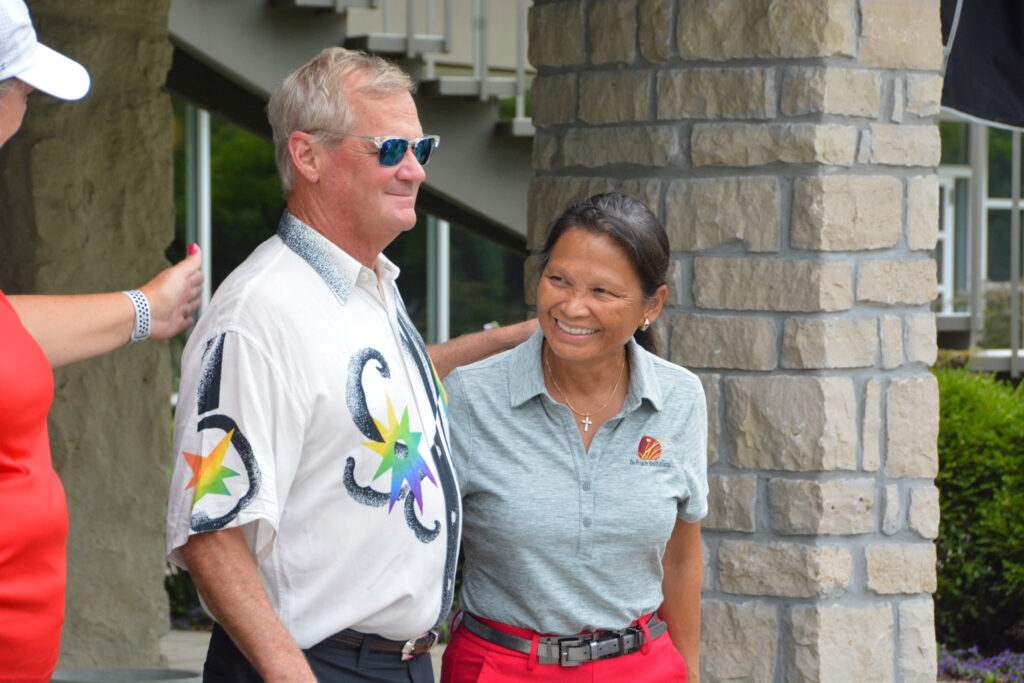
Dr. Cusick & Barbara Cusick smile while being thanked at the Prairie Invitational awards ceremony.
The weather controlled the opening round; the event began with an hour delay due to heavy rains that continued at the beginning of play on Monday. Julia Misemer, the soon-to-be Freshman at the University of Arizona, got off to a hot start with an opening round of 72 which consisted of three birdies and an eagle. There were seven rounds of 75 as well including one shot by Kansas Women’s Amateur champion, Maya McVey. The weather cleared in the afternoon on the first day and the clear weather carried over into the second day of the event.
Misemer held her lead following day two, she shot two under in the second round with six birdies. Aristelle Acuff shot even par round on day two to find herself five shots back headed into the last round. Abby Glynn found her one-shot back of Acuff headed into the last round. Acuff was able to narrow the gap to four and headed into the back nine of the final round. Misemer suffered a double on hole sixteen narrowing the lead to just two. Acuff and Misemer made a birdie on the last resulting in Misemer’s first Prairie Invitational victory, earning her the title of Low Junior too.
Julia Misemer tees off on the fourth hole during round two.
The Alane Studley Low Senior
New to the tournament was the Alane Studely Low Senior Award. This award was named to honor the life and legacy of Alane Studley, who was a Central Links Golf Board Member and avid golfer. Martha Linscott won the award shooting rounds of 82-80-162.
Craig Studley (left), the husband of Alane, stands next to Low Senior winner, Martha Linscott (right)
Opal Hill Division
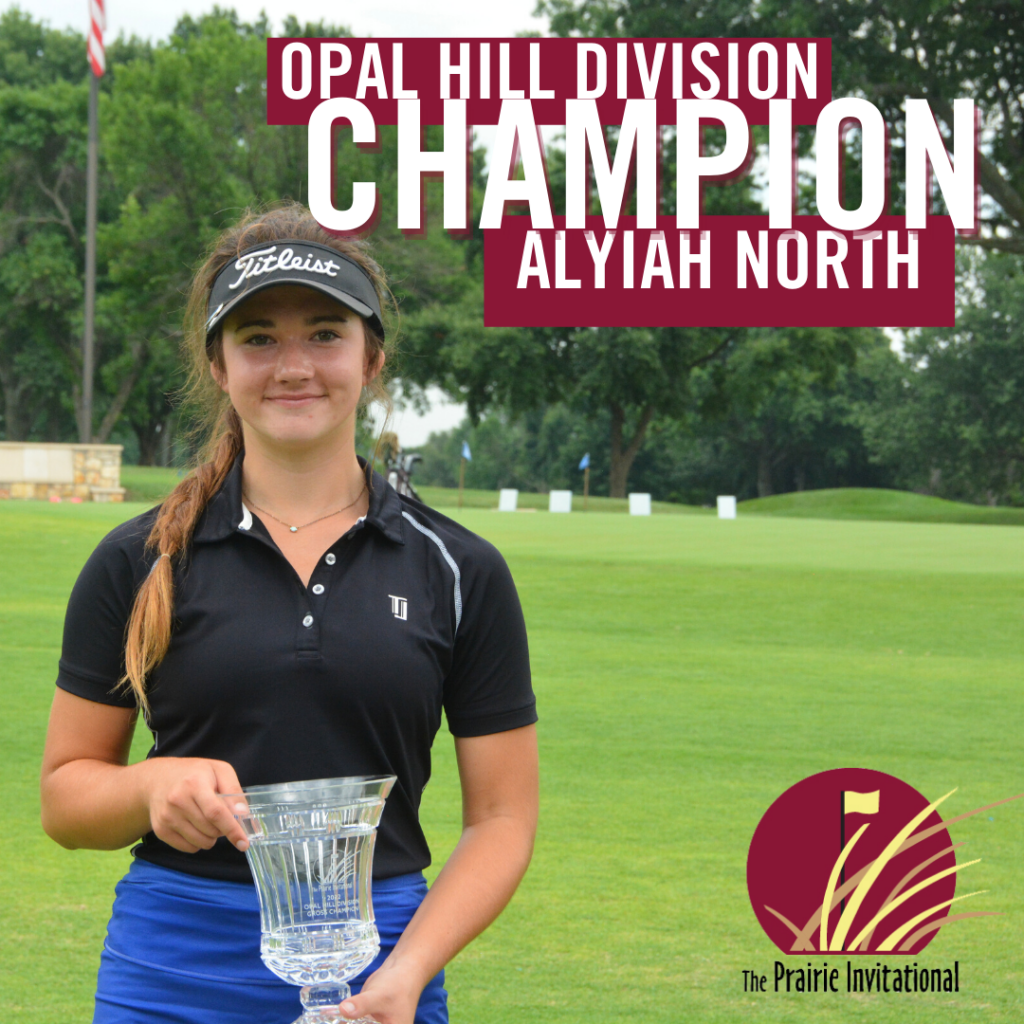
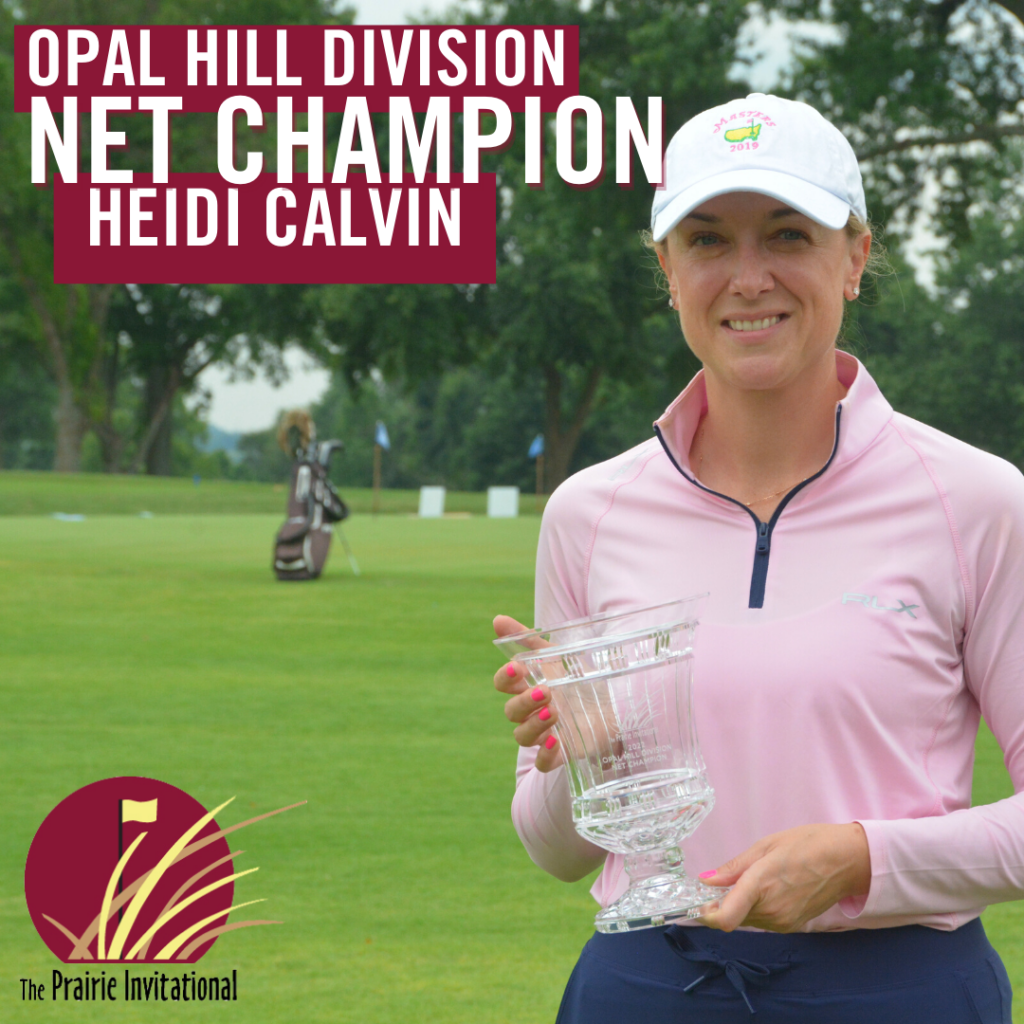
The Opal Hill Division is 36 holes. Aliyah North held the lead after day one with a round of 82. Home course favorite and defending champion, Diane Sparks shot a round of 83. North controlled the lead the entire day in the Gross division with a final round of 74 headlined by a bogey-free 35 on the front. North won in commanding fashion, and Annie Johnsen and Charley Strahm finished in a tie for second. The net division was won by Heidi Calvin, who shot net rounds of 74 and 71 to win the title.
The Prairie Invitational had another successful year by raising over $30,000 Girls Performance Initiative. The 2023 Prairie Invitational will be played at Kansas City Country Club in honor of the tenth anniversary of the event.
It was a hot week at the Kansas Women’s Amateur presented by Mommy’s Helper, with temperatures climbing into the mid-90s, the greens became dry and fast, making the already challenging Topeka Country Club, even more difficult.
Emerie Shartz, a fourteen-year-old from Wichita, was leading the event after shooting 70-76 on Monday. Maya McVey, an incoming Senior at Blue Springs South High School, fired an impressive round of 71 on Tuesday to put her in contention after shooting 75-78 on Monday.
After Shartz had a few hiccups on her back nine, she was tied with McVey at five-over-par for the tournament, leading to a playoff on the 18th hole.
Both girls hit impressive drives just short of the green on the 277-yard par-4. They both proceeded to hit their chip shots close to the hole. Shartz just barely missed her putt, making par. McVey was next to play and sunk her short 2-footer to win.
“Through all three rounds, I was just trying to keep a relaxed mindset,” McVey said, “My approach shots were the best part of my game this week, I was hitting them all pin-high…they were like darts,” she added when asked what led to her victory.
Shartz and McVey won Low Junior honors. Martha Linscott of Mission Hills won Low Senior after shooting 78-82-85.
Other notable players included home course favorite, Megan Lucas who shot 77-75-75, earning her solo-third place. Megan Whittaker from Elkhorn, Nebraska shot 77-70-81 was in solo-fourth. Local Kansas golfers, Abby Glynn (Topeka), Kinslea Jones (Wichita), and Hanna Hawks (Wichita) each tied for fifth place.
Ladies Wrap Up Play During Day 1 of the 2022 Kansas Women’s Amateur Championship
TOPEKA, KS – Day 1 of the Kansas Women’s Amateur has ended with the completion of Rounds 1 & 2, hosted at The Topeka Country Club in Topeka, KS Monday evening. The event is sponsored by Mommy’s Helper.
The 2022 Kansas Women’s Amateur has kicked off at The Topeka Country Club, a golf course with a rich history of hosting Kansas Championships. The field of 56 is filled with the top players in the state, fighting for the Women’s Amateur trophy in our 54-hole championship. With few clouds in the sky and the sun shining all over, the course was in perfect shape, playing at 6,029 yards. The tree-lined golf course has the feel of an old-style country club, with narrow fairways and slick greens, adding a challenge to the championship.
As the wind started to pick up later in the evening, players faced more challenges towards the end of the round, except for Emerie Schartz and Megan Whittaker, who both shot under-par rounds today. Emerie shot a 70 in Round 1 with five birdies and two bogies, and a 76 in Round 2 to put her at even par through Day 1. Megan Whittaker finished Round 1 with a 77, but turned on the fire in Round 2 with five birdies and two bogies, ending with a score of 70 and putting her at 1 over par through Day 1.
The final round of the Kansas Women’s Amateur Championship continues tomorrow as Emerie Schartz and Megan Whittaker battle to secure the win. With multiple scores just above par, the race will be tight as the first group of ladies tee off at 7:30 a.m. CT. Live scoring will be posted throughout the day, and available on our website.
The Kansas City Women’s Match Play presented by Granite Garage Floors was held this week at Hillcrest Golf Course.
Aristelle Acuff, a graduate student on the Georgia State Women’s Golf Team, was victorious at the Kansas City Women’s Match Play on Wednesday. Acuff who was the two seed, defeated Abby Glynn the one seed 3&2 in the final match.
Acuff, who shot 74 in the stroke-play qualifier said “the results from the stroke-play qualifying gave me a lot of confidence and momentum heading into match play. There were a lot of good players in the field, I thought I had put myself in a solid position to go all the way.”
Going into her final round she knew it would be a tough match. Glynn and Acuff were former teammates at Kansas University, “Abby is a great golfer and we have a very similar golf game. I just wanted to keep it simple and stay in the moment,” Acuff noted.
On the 7th hole, a par-three, Acuff hit a solid tee shot into the green and stuck it to about three feet. Without missing a beat, Glynn followed it up by hitting her tee shot a similar distance from the hole. “I think that sums up the type of golf that was played today,” Acuff said, “It was a blast getting to play against Abby. I got this one, but I know Abby will be waiting for the next one!”
In the Silver Bracket, Sam Maceli defeated Faith Hedges 3&2.
The Kansas Junior Amateur held at Ironhorse was an extremely competitive tournament for both the boys and the girls. Kinslea Jones held a 6 shot lead headed into the final round. Jones never let that lead slip. She turned in 36, carding a bogey and a birdie. She then caught fire on the back nine making four birdies in route to a 69. She finished as the only person in the entire tournament under par. She shot a 215(73,73,69). Jaylee Castro continued her success from last week finishing runner up. Castro shot a 222(83,69,70). Emerie Schartz (79,72,73) and Kate Tilma (77,73,74) finished in a tied for third with a three-day total of 224.
Will King took home the title on the boys side. Coming off his state title in Missouri, Will King was a favorite to win the tournament. It wasn’t an easy day for King, but the entire final group struggled most of the day to get anything started. King had enough in the gas though to win by a comfortable margin. King shot 217(73,72,72) which included 4 birdies today. Brady Rapp was runner up with a score of 221(73,73,75), 4 shots back of King. Jacob Fratzel got third with a score of 222(76,69,77). The boys division had winners in each age group and those are listed below.
14&under
Brady Rapp – 221(73,73,75)
Parker Bennett – 228(79,68,81)
Titus Johnson – 234(80,78,76); Colt Farrow – 234(82,72,80)